Blue Ocean Strategy Summary for Entrepreneurs (Create Uncontested Markets)
Most entrepreneurs try to beat competitors.
Few try to make competition irrelevant.
When I first read Blue Ocean Strategy, I realized something powerful: growth doesn't come from fighting harder — it comes from thinking differently.
Written by W. Chan Kim and Renée Mauborgne, Blue Ocean Strategy explains how businesses can escape crowded markets and create entirely new demand.
This isn't just theory. It's a strategic framework entrepreneurs can apply immediately.
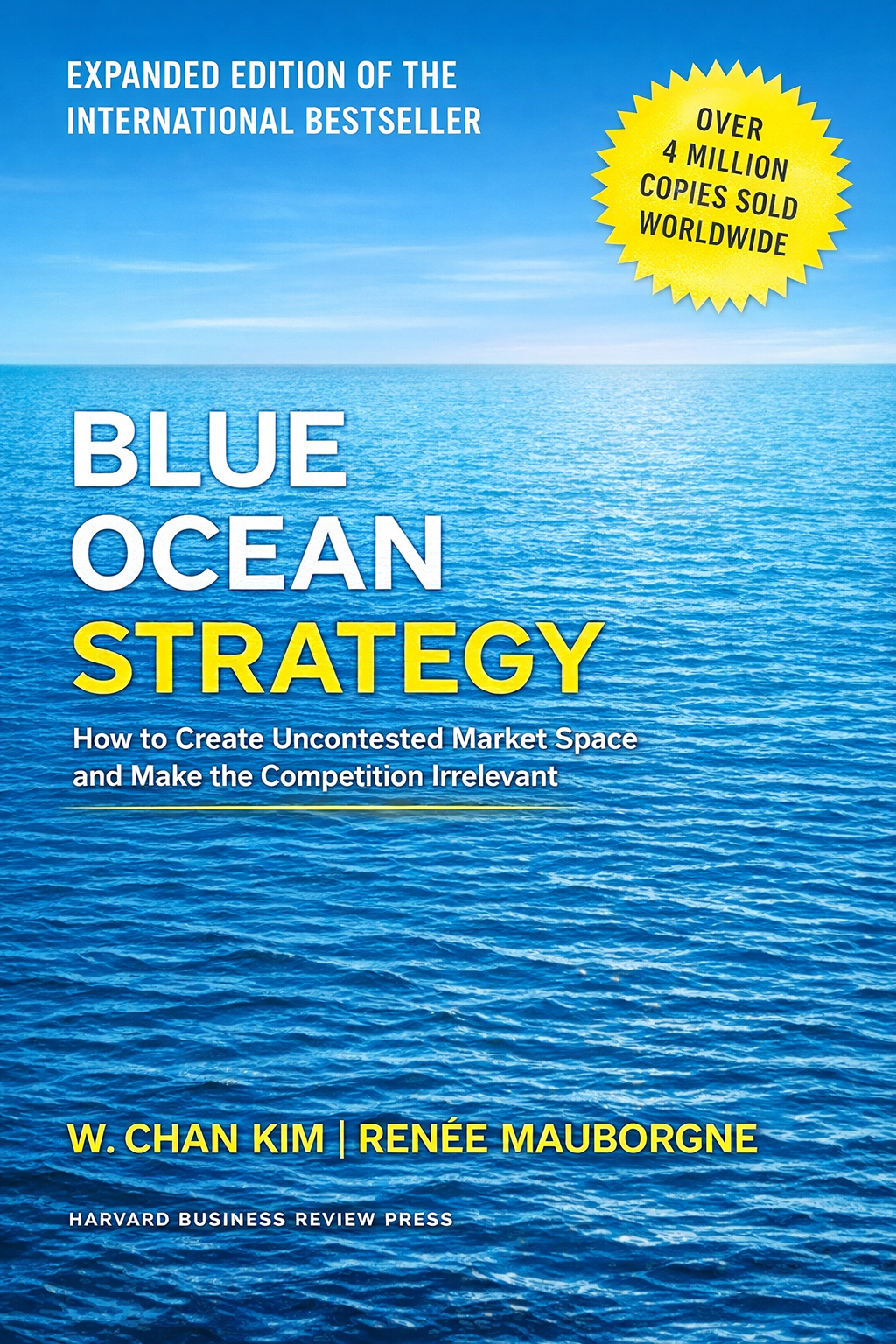
What Is Blue Ocean Strategy About?
The book divides markets into two types:
- Red Oceans - Existing markets filled with competition.
- Blue Oceans - Untapped markets with little or no competition.
Red oceans fight over existing demand. Blue oceans create new demand.
Entrepreneurs succeed long term not by competing harder — but by creating uncontested space.
Core Concepts Explained for Entrepreneurs
1. Value Innovation
Blue Ocean Strategy is built on one central idea: Value Innovation.
Instead of choosing between differentiation and low cost, you pursue both simultaneously.
The goal is to deliver unique value while reducing unnecessary costs.
Entrepreneurs must ask:
How can I increase value and reduce waste at the same time?
2. The Four Actions Framework
The book introduces four powerful questions:
- Eliminate - What factors can be removed entirely?
- Reduce - What factors can be reduced below industry standard?
- Raise - What factors should be raised above standard?
- Create - What new factors can be introduced?
This forces entrepreneurs to rethink industry assumptions.
3. Strategy Canvas
A strategy canvas visually compares your offering with competitors.
It reveals:
- Where industries over-invest
- Where they under-deliver
- Where differentiation opportunities exist
Entrepreneurs can use this tool to redesign positioning.
4. Focus on Noncustomers
Most companies focus only on existing customers.
Blue Ocean thinking asks:
Why are people not buying from this industry?
Unlocking noncustomers expands markets dramatically.
5. Make Competition Irrelevant
The ultimate goal isn't beating competitors — it's making them irrelevant.
When you create new demand, price wars and feature wars disappear.
How Blue Ocean Strategy Applies in 2026
Modern examples include:
- AI-powered micro-niche SaaS tools
- Creator-led education platforms
- Subscription communities
- Vertical software for underserved industries
Entrepreneurs today don't need massive capital. They need differentiation clarity.
Instead of entering crowded markets, create your own category.
Blue Ocean Strategy vs Zero to One
Zero to One Summary for Entrepreneurs focuses on building monopoly businesses through breakthrough innovation.
Blue Ocean Strategy focuses on creating uncontested markets through value innovation.
One emphasizes unique technology. The other emphasizes strategic differentiation.
Combined, they create powerful startup positioning.
Blue Ocean Strategy vs The Lean Startup
The Lean Startup Summary for Entrepreneurs teaches how to test ideas quickly.
Blue Ocean Strategy teaches how to design differentiated ideas in the first place.
One optimizes validation. The other optimizes positioning.
Who Should Read Blue Ocean Strategy?
- Startup founders
- Product strategists
- Business owners entering crowded markets
- Entrepreneurs seeking differentiation
If your market feels saturated, this book is essential reading.
Key Quotes
“The only way to beat the competition is to stop trying to beat the competition.”
“Value innovation is the cornerstone of blue ocean strategy.”
Action Plan for Entrepreneurs
- Map your industry using a strategy canvas.
- Apply the Four Actions Framework.
- Identify noncustomers.
- Eliminate unnecessary cost factors.
- Create new value propositions competitors ignore.
Create demand. Don't fight over it.